


 Written by
 Yamal’s Gesture to Messi Shows the Heart of Football
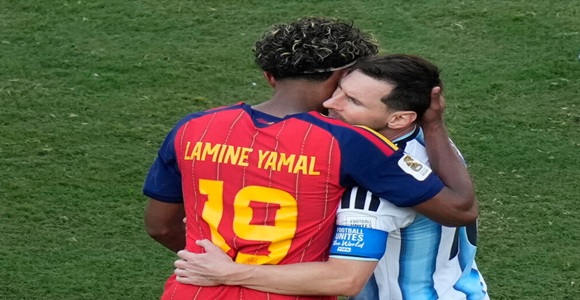
The World Cup final ended with two completely different pictures. On one side of the pitch, Spain’s players were disappearing beneath a wave of red shirts, substitutes, coaches and flags. Their supporters were roaring from the stands, celebrating the country’s second world title after Ferran Torres produced the decisive goal in extra time. On the other side, Lionel Messi remained seated on the grass, absorbing the pain of Argentina’s 1–0 defeat. The captain who had experienced nearly every possible emotion in football suddenly looked alone amid the noise. Spain had won the trophy, Argentina had lost its crown, and the stadium was preparing for a celebration. Yet Lamine Yamal briefly stepped away from his teammates and walked towards Messi. The 19-year-old embraced the 39-year-old legend and offered him comfort. It was a simple human gesture, but in that moment it became as memorable as almost anything that had happened during the match.
There was no elaborate ceremony and no need for a speech. Yamal did not approach Messi because cameras were waiting or because football tradition demanded it. Spain’s young star had every reason to run towards his family, lift the trophy and celebrate the greatest victory of his career. Instead, he noticed the suffering of the opponent he had just defeated. He crossed the emotional distance separating victory from heartbreak and acknowledged Messi not as a rival standing in Spain’s way, but as a footballer confronting one of the most painful moments of his career. Reports described Messi sitting on the pitch after the final whistle before Yamal approached and embraced him. Their brief interaction quickly became one of the defining images of the final. FOX Sports and Goal both presented the moment as an emotional meeting between two generations.
The meaning of the embrace was strengthened by the extraordinary contrast between the two players. Yamal was appearing in his first World Cup final, at the beginning of a career that already appears capable of reaching remarkable heights. Messi, playing at the age of 39, was competing in his third final and possibly his last World Cup match. Their birthdays are separated by 20 years and 19 days, an age difference that made their presence on opposite sides of the same final historic. Yamal was chasing the first World Cup of his young career; Messi was trying to protect the trophy Argentina had won in Qatar. One represented football’s rapidly approaching future. The other carried the history of an entire era on his shoulders. When they embraced, the distance between those two worlds suddenly disappeared.
It would be easy to describe the moment as a “passing of the torch,” but that familiar expression does not fully capture what happened. Messi did not surrender his greatness to Yamal, and Yamal did not require Messi’s symbolic permission to become a leading figure in world football. Greatness is not a physical object handed from one player to another. What passed between them was something more personal: recognition. Yamal recognised the scale of Messi’s disappointment, while Messi stood to receive the teenager who had come to console him. The moment suggested that football’s generations do not always need to replace or diminish one another. They can meet with respect. The rise of a new star does not erase the achievements of the legend who came before him.
Their connection extends well beyond that final. Both emerged from Barcelona’s La Masia academy, although they never played together for the club. Messi left Barcelona in 2021, two years before Yamal made his senior debut. Nevertheless, Yamal grew up surrounded by the footballing culture Messi had transformed. Every young Barcelona attacker who receives the ball near the right touchline is inevitably measured against the Argentine. Every dribble, left-footed finish and moment of imagination encourages comparisons. Yamal has repeatedly tried to establish his own identity, but the shadow of Messi remains part of the environment in which he developed. The embrace therefore carried the emotional weight of a young graduate honouring the greatest player produced by the same footballing school.
There is also an almost unbelievable image connecting the beginning of Yamal’s life with the early years of Messi’s career. In 2007, a 20-year-old Messi participated in a charity calendar photoshoot organised with UNICEF and Barcelona. During the session, he was photographed helping to bathe a baby who happened to be Lamine Yamal. Yamal’s family had been paired with Messi after being selected through a raffle. At the time, nobody could have known that the baby in the small plastic bath would eventually face Messi in a World Cup final. The photographs resurfaced during Yamal’s emergence at Euro 2024 and became even more powerful when Spain and Argentina reached the 2026 final. What began as a chance charity encounter returned almost two decades later as one of football’s most remarkable full-circle stories. The Sun’s account of the photograph traces its origin to that UNICEF calendar project.
The final itself had been fierce enough to make the tenderness of the embrace feel even more striking. Spain controlled possession and repeatedly pushed Argentina back, but the defending champions resisted for more than 100 minutes. Argentina goalkeeper Emiliano Martínez kept the contest scoreless as the tension grew. Enzo Fernández’s dismissal late in regulation time left Argentina playing extra time with ten men, increasing Spain’s territorial advantage and forcing Messi to operate with increasingly limited support. Torres eventually found the breakthrough in the 106th minute, scoring the goal that gave Spain its first world championship since 2010. For Spain, the strike released years of ambition. For Argentina, it created a countdown towards the end of their reign.
When the final whistle arrived, the emotional contrast was brutal. One group of players had just achieved the dream that defines international football; the other had come within one match of defending the World Cup. Modern football often encourages players to celebrate without restraint. Cameras search for tears, collapsed bodies and dramatic reactions. Social media quickly divides every final into heroes and failures. Yamal’s response resisted that division. He celebrated Spain’s victory, but he did not treat Argentina’s pain as entertainment. By approaching Messi, he showed that compassion for a defeated opponent does not weaken the joy of winning. If anything, it gives victory greater dignity.
That matters because elite football is increasingly presented through conflict. Players are judged according to rivalries, statistics and online arguments. Supporters are encouraged to choose one star by attacking another: Messi against Cristiano Ronaldo, one generation against the next, established legends against emerging talents. Yamal has already been pulled into that culture of comparison. Every outstanding performance produces new claims about how close he might come to Messi’s records. The embrace offered a different vision. Yamal did not need to humiliate Messi to announce his arrival, and Messi’s sadness did not reduce the greatness of his career. Respect allowed both stories to exist at the same time.
The gesture also revealed something important about Yamal himself. Talent explains why he can decide matches, escape defenders and perform under enormous pressure. Character determines how he behaves when the contest is over. At 19, after becoming a world champion, it would have been understandable for him to think only about his own achievement. Instead, he remained aware of another person’s emotions. This was not the performance of a young footballer overwhelmed by his new status. It was the response of someone sufficiently secure in victory to recognise suffering. For supporters wondering what kind of global star Yamal might become, that brief walk towards Messi offered an encouraging answer.
Messi’s role in the moment should not be overlooked either. Defeat in a World Cup final is difficult for any player, but this loss carried particular weight. Messi had led Argentina to the 2022 championship and then, four years later, helped the team reach another final while scoring eight goals during the tournament. He had already experienced World Cup heartbreak against Germany in 2014 before finally lifting the trophy in Qatar. At 39, there was no guarantee that another opportunity would come. His disappointment was therefore not simply about losing one game. It was connected to the possible ending of a World Cup journey stretching across six tournaments. Even in that pain, however, he acknowledged Yamal’s approach. Their embrace became a shared act of sportsmanship rather than a one-sided display of sympathy.
Football supporters often say that the game is about more than trophies, but finals test whether that belief is genuine. The World Cup trophy is the highest prize the sport can offer. Careers are defined by it, reputations transformed by it and national memories built around it. Yet the moment between Yamal and Messi reminded viewers that the value of football cannot be measured only by who lifts the cup. The game also matters because it produces encounters between people from different generations, countries and experiences. It allows admiration to survive competition and humanity to appear even when emotions are at their most extreme.
Years from now, Spain’s supporters will remember Torres’ goal and Rodri lifting the trophy. Argentina’s fans will remember their team’s resistance and the painful sight of Messi after the final whistle. The statistics will record a 1–0 victory after extra time, Spain’s second world championship and the end of Argentina’s title defence. But football memory is rarely made from numbers alone. It is made from images: a player collapsing at the whistle, a captain raising the cup, a supporter crying in the stands and a young champion leaving his celebration to comfort a defeated legend.
Yamal’s embrace did not change the result, return the trophy to Argentina or remove Messi’s pain. It achieved something smaller and, in its own way, more enduring. It reminded millions of viewers that an opponent is not an enemy and that triumph does not require cruelty. Spain won the World Cup because of what its players did with the ball. Yamal helped define the spirit of the final through what he did after the ball had stopped moving. In the middle of celebration and heartbreak, a 19-year-old approached a 39-year-old, offered him respect and showed why football, at its best, remains a profoundly human game.
Reference links
- Lionel Messi, Lamine Yamal share emotional hug after Spain’s FIFA World Cup triumph[timesofindia.indiatimes]
- PIX: Lamine Yamal consoles Lionel Messi after FIFA WC Final[rediff]
- Watch: Messi and Yamal share emotional hug after Spain’s World Cup Triumph[thesportstak]
- FIFA World Cup: Yamal consoled Messi after final, hugs him; moment goes viral[indiatoday]
- Lamine Yamal Embraces Lionel Messi After Spain Beats Argentina In World Cup Final[foxsports]
I can also rewrite this into a more journalistic news article, a social media post, or a short fan blog post.