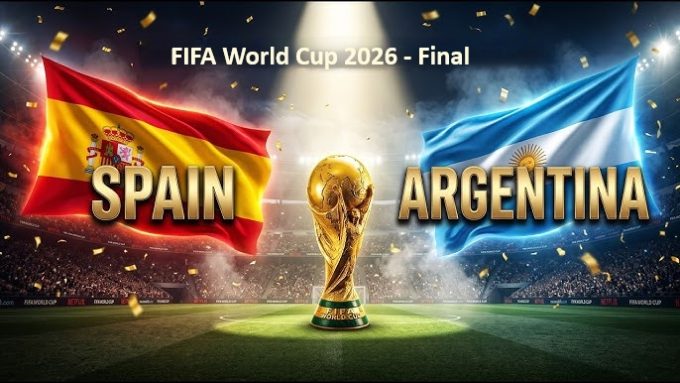
An analytical reconstruction of the 2026 World Cup final: tactical pressure, disciplinary collapse and the economics surrounding football’s biggest match
| RESULT | DECISIVE GOAL | POSSESSION | ATTENDANCE |
| Spain 1–0 Argentina (a.e.t.) | Ferran Torres, 106′ | Spain 62% / Argentina 38% | 80,663 |
The result was narrow; the underlying contest was not
A single extra-time goal separated Spain and Argentina at MetLife Stadium, but the 1–0 scoreline compresses a much clearer competitive pattern. Spain owned territory, generated three times as many attempts and repeatedly forced Argentina to defend without the ball. Argentina remained alive because the match stayed goalless—not because it had found a sustainable way to threaten Spain.
That distinction matters. Finals are often described through isolated moments, yet this one was decided by an accumulation of pressure. Spain’s 62% possession was not decorative circulation: it produced 18 shots, seven on target and nine corners. Argentina managed six attempts and one on target across the full match. The champions therefore did not simply survive a balanced game and strike late. They kept increasing the probability that one clean action would eventually settle it.
Two routes to the final, two different risk profiles
Spain arrived with the stronger structural case. Luis de la Fuente’s side had gone 37 matches without defeat, matching Italy’s national-team record, and conceded only once during the tournament. Its knockout path—Austria, Portugal, Belgium and France—suggested a team comfortable winning in more than one register: by controlling space, suppressing chances and converting without needing a chaotic game.
Argentina’s route revealed a different strength. Lionel Scaloni’s defending champions repeatedly found solutions late, defeating Cape Verde, Egypt, Switzerland and England while leaning on timing, resilience and the individual influence of Lionel Messi, Lautaro Martínez and Enzo Fernández. The semifinal comeback against England, completed through goals in the 85th minute and stoppage time, reinforced Argentina’s belief that a match could be rescued even after the plan had begun to fray.
In the final, however, that survival instinct met a team designed to reduce volatility. Spain denied Argentina the open exchanges in which Messi and Martínez could turn a few possessions into decisive attacks. As the minutes passed, Argentina’s usual capacity for a late intervention became less a strategy than a hope.
How Spain converted possession into control
Spain’s main achievement was not simply keeping the ball; it was controlling where Argentina could use it. By sustaining pressure around the Argentine penalty area, Spain shortened the field and made counterattacks begin farther from goal. Argentina could still break, but those attacks were scattered and increasingly dependent on perfect execution from its senior forwards.
The statistical profile captures the imbalance. Spain led 18–6 in total shots, 7–1 in shots on target and 9–3 in corners. Those numbers point to repeat access, not one extraordinary burst. Argentina’s 18 fouls, compared with Spain’s 12, also indicate the defensive cost of spending longer without control. Each recovery demanded another sprint, duel or interruption; each failed transition returned the initiative to Spain.
The 0–0 score after 90 minutes therefore represented Argentina’s best argument and Spain’s main frustration. Spain had done almost everything required to dominate a final except finish. Argentina, meanwhile, had compressed the contest into a single-event game—the exact scenario in which Messi’s creativity or Martínez’s movement might still overturn the balance.
The dismissal removed Argentina’s final source of leverage
Enzo Fernández’s red card was the match’s decisive change in conditions. Booked in the 82nd minute for dissent, he received a second yellow in the third minute of stoppage time after a challenge on Pau Cubarsí. Argentina entered extra time with ten players, losing both a midfielder and the realistic ability to maintain an aggressive transition threat.
With equal numbers, Argentina could at least force Spain to respect the counterattack. With ten, every forward run carried a larger defensive cost, and every Spanish switch of play made the reduced block travel farther. The dismissal did not create Spain’s superiority; it converted an existing edge into near-continuous control. Argentina’s margin for error, already thin, disappeared.
Ferran Torres supplied the finish in the 106th minute. His long-range strike—his first goal of the tournament—was dramatic because of its timing, but analytically it was the endpoint of the game’s central trend. Spain had accumulated territory and attempts until a shot finally broke the deadlock. Argentina’s late push produced urgency, not a comparable threat.
A final that functioned as both match and global product
The football unfolded inside an event engineered on a much larger commercial scale. MetLife Stadium, selected in 2024, placed the final in an 82,500-seat venue already associated with the Super Bowl and FIFA’s expanded club competition. Tickets reportedly began around $4,000 and rose into the tens of thousands for premium locations. The prize structure was similarly enlarged: $62 million for the champion and $33 million for the runner-up.
The clearest symbol of this expansion was the first World Cup final halftime production modeled on the Super Bowl. Madonna, Shakira, Justin Bieber, Burna Boy, BTS, Coldplay, Gustavo Dudamel, the PS22 Chorus and other guests were presented as part of a charity campaign intended to support a $100 million education fund. Yet the spectacle extended the interval to 27.5 minutes, creating an obvious tension between audience growth and the sport’s established 15-minute rhythm.
That tension is more consequential than a debate about entertainment preferences. A longer interval changes the competitive environment: players cool down, coaches gain additional intervention time and broadcasters acquire more premium inventory. The final therefore became a test of how far FIFA could import the commercial logic of American sports without altering football’s internal cadence.
The title’s meaning extends beyond the trophy
For Spain, a second world championship completed a 16-year arc from the 2010 winners to a new generation. Rodri lifting the trophy provided continuity with Spain’s control-oriented identity, while 19-year-old Lamine Yamal embodied its renewal. Having already won the European Championship, Yamal’s World Cup victory placed him in an unusually small historical category of teenagers collecting the sport’s largest international honors.
For Argentina, the defeat closed the attempt to defend the title won in Qatar and may have marked Lionel Messi’s final World Cup appearance. The loss did not erase Argentina’s ability to navigate difficult knockout matches, but it exposed the limitation of depending on late-game improvisation against an opponent that can monopolize both territory and time.
The ceremony also showed how FIFA is reframing victory as a broader entertainment property. President Gianni Infantino and U.S. President Donald Trump presented the medals, while championship rings—an explicit borrowing from NFL culture—supplemented the traditional trophy. Of 2,026 rings produced, only 30 were designated for the winning squad and staff; the rest were planned as licensed products. The symbolism was unmistakable: the champion’s identity was being converted into a collectible market.
Controversy remained part of the event’s architecture
Several episodes competed with the sporting narrative. Before kickoff, coverage revisited referee Slavko Vinčić’s presence as a witness in a 2020 Bosnian police operation, despite his release without charge and FIFA’s decision to retain his appointment. After the final whistle, players from both teams were involved in a brief confrontation, reportedly sparked by Leandro Paredes. During the medal ceremony, sections of the crowd booed Infantino and Trump.
Taken together, these moments illustrate the vulnerability of a modern mega-final: the larger the spectacle, the more institutions, personalities and commercial interests become attached to its meaning. FIFA sought a seamless global production; the event instead generated multiple narratives about governance, celebrity and political visibility alongside the match itself.
Final assessment
Spain won because its advantages were repeatable. Possession led to territory; territory led to shots; sustained pressure increased Argentina’s disciplinary and physical burden. Fernández’s dismissal accelerated the process, and Torres supplied the decisive execution, but neither moment was detached from what came before.
The final’s broader significance lies in the contrast between a restrained sporting outcome and an expansive commercial presentation. On the field, Spain prevailed through patience, structure and risk control. Around it, FIFA pushed the World Cup final toward a hybrid of football match, concert, charity platform, political stage and retail franchise. Spain’s victory was precise and economical. The event built around it was anything but.
Editorial note: This rewrite is based exclusively on the facts and claims in the supplied article. It reorganizes them into an analytical narrative and does not independently verify the source’s references.