Professional road racing is the pinnacle of competitive cycling—a grueling, tactical, and deeply strategic sport held primarily on paved roads across the globe. It combines raw endurance, explosive power, and sophisticated team tactics in a discipline that has captivated fans for more than a century.
## Origins and History
Professional road racing originated in **Western Europe**, with its strongest historical roots in **France, Spain, Italy, and the Low Countries** (Belgium and the Netherlands). The sport dates back to the **late 1800s**, when organized competitions began emerging across Europe as cycling technology and infrastructure improved. Road cycling has been an **Olympic sport since 1896**, making it one of the longest-running Olympic disciplines [gccoaching](https://gccoaching.fit/2016/01/11/bicycle-road-racing-101-types-of-races-and-rider-disciplinesroles/)[youtube](https://www.youtube.com/watch?v=eYLm3liCTC0).
## Governance and Structure
The sport is governed by the **UCI (Union Cycliste Internationale)**, the international federation responsible for cycling’s rules, calendars, and rankings. The UCI organizes annual **World Championships** for both men and women, awarding the coveted rainbow jersey to the world champion in various categories [youtube](https://www.youtube.com/watch?v=eYLm3liCTC0).
The UCI oversees multiple tiers of professional racing, including:
– **UCI WorldTeam** (top-tier professional teams)
– **UCI ProTeam** (second-tier professionals)
– **Continental teams** (semi-professional and amateur levels)
Racing now takes place at professional, semi-professional, and amateur levels worldwide, though Europe remains the sport’s heartland.
## The Grand Tours: Cycling’s Crown Jewels
The **Tour de France** is the most prestigious event in professional cycling—a three-week race held annually in July that can attract **500,000+ roadside spectators per day** [youtube](https://www.youtube.com/watch?v=eYLm3liCTC0). The race covers approximately 3,500 kilometers (2,200 miles) across France and occasionally neighboring countries, featuring flat stages, mountain climbs in the Alps and Pyrenees, individual time trials, and dramatic sprint finishes.
The other two Grand Tours complete cycling’s most coveted triad:
– **Giro d’Italia** (May): Known for its brutal mountain stages and passionate Italian fans
– **Vuelta a España** (September–October): Features challenging terrain and often decisive late-race climbs
Winning any Grand Tour requires exceptional endurance, tactical intelligence, and team support. The overall winner wears the iconic jersey (yellow for Tour de France, pink for Giro, red for Vuelta) and is celebrated as one of the world’s elite cyclists.
## Race Formats and Disciplines
### Mass-Start Races
The most common format, where all riders start simultaneously (though sometimes with handicaps) and race to a set finish point. The first rider to cross the line wins.
### Time Trials
Individual riders or teams race alone against the clock on a fixed course. Time trials test pure speed, aerodynamics, and pacing strategy. Team time trials (TTT) see squads race together, with the team’s time recorded on the fourth rider’s finish.
### Stage Races
Multi-day events consisting of several mass-start or time-trial stages ridden consecutively. The overall winner is determined by the lowest cumulative time across all stages. Besides the Grand Tours, prestigious stage races include:
– Paris–Nice
– Tirreno–Adriatico
– Tour de Suisse
– Critérium du Dauphiné
– Tour Down Under
### One-Day Classics
Brutal, single-day races often held on traditional routes with challenging terrain. The “Monuments” are the five most prestigious classics:
– **Milan–San Remo** (Italy) – longest classic, ~300 km
– **Tour of Flanders** (Belgium) – cobblestones and steep climbs
– **Paris–Roubaix** (France) – “Hell of the North” with iconic cobblestone sectors
– **Liège–Bastogne–Liège** (Belgium) – oldest classic, demanding climbs
– **Giro di Lombardia** (Italy) – race of the falling leaves, autumn classic
## Rider Specialties and Team Roles
Professional road racing is fundamentally a **team sport**, even though individual riders win races. Each rider has a specialized role:
| Role | Description | Key Skills |
|——|————-|————|
| **Sprinter** | Explosive finisher who dominates flat stages and sprints to victory | Raw power, fast-twitch muscles, positioning in final kilometers |
| **Climber** | Excels on steep mountain terrain; gains time on high-altitude stages | High power-to-weight ratio, sustained efforts on climbs |
| **Puncheur** | Specialist on short, steep climbs (e.g., Mur de Huy) | Explosive power on hills, technical descending |
| **All-rounder** | Strong across all terrains; often the Grand Tour leader | Balanced skills, endurance, tactical intelligence |
| **Domestique** | Works selflessly for the team leader | Drafting, fetching supplies, protecting from wind and crashes, sacrificing personal results |
### Tactical Essentials
Road racing tests **stamina, fitness, and tactical acumen** in equal measure. Teams strategically restrict rivals’ gains on their strengths while maximizing their own on preferred terrain. Key tactics include:
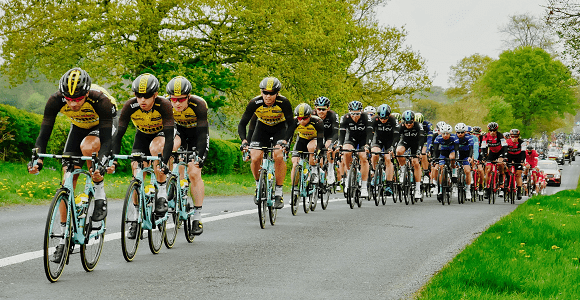
– **Drafting (paceline):** Riding closely behind other cyclists to reduce wind resistance and save 30–40% energy
– **Positioning:** Staying near the front of the peloton to avoid crashes and be ready for attacks
– **Breakaways:** Small groups attacking to gain time before the peloton reacts
– **Final-kilometer sprints:** Coordinated lead-out trains delivering sprinters to the finish at maximum speed
[staffordrc](http://www.staffordrc.org/road-racing/)
## Race Distance and Duration
Professional road races vary dramatically in length:
– **One-day classics:** 200–300+ km (124–186 miles), lasting 5–7 hours
– **Grand Tour stages:** 100–250 km (62–155 miles), lasting 3–6 hours
– **Time trials:** 10–50 km (6–31 miles), lasting 15 minutes to 1 hour
Elite riders regularly cover **30–40+ km/h (18–25+ mph) average speeds**, with peaks exceeding **60 km/h (37 mph)** on flat descents and sprints.
## Modern Professional Road Racing
Since the mid-1980s, the sport has diversified globally, with races held at professional, semi-professional, and amateur levels worldwide. Advances in **cycling technology, sports science, nutrition, and data analytics** have transformed training and performance. Modern riders benefit from:
– Power meters and heart rate monitors
– Aerodynamic bike design and equipment
– Personalized nutrition and recovery protocols
– Video analysis and tactical preparation
– Advanced medical support and injury prevention
Despite these modernizations, the fundamental challenge remains: **survive the peloton, exploit weaknesses, and sprint or climb to victory** in a sport that rewards both individual brilliance and team loyalty.
## Why Road Racing Captivates Millions
Road racing combines **human drama, athletic excellence, and natural beauty**. Races traverse picturesque countryside, climb legendary mountains, and roar through historic city centers. The tension of a breakaway, the strategy of a team lead-out, the agony of a mountain climb, and the explosive finish of a sprint create unforgettable moments that define sports history.
The sport’s accessibility—anyone can ride a bike on public roads—also makes it uniquely relatable. Fans can watch the Tour de France pass through their town, attend local club races, or even participate in amateur events and sportives.
***
**Ready to get started?** Whether you’re drawn to the drama of the Grand Tours, the brutality of the classics, or the strategy of team racing, professional road racing offers endless excitement for athletes and fans alike. Want a beginner’s guide to licenses, clubs, equipment, and first race types—or a deeper dive into Grand Tour tactics and rider roles?