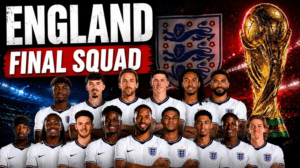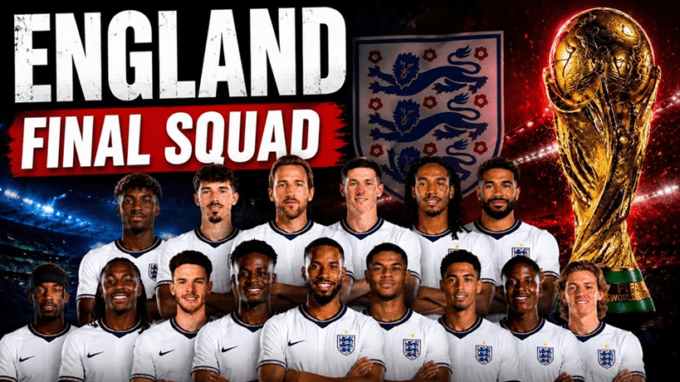
England’s 2026 FIFA World Cup squad has finally been revealed, and the selection has sparked debate, analysis, and optimism across the football‑loving public. The 26‑man roster reflects a blend of seasoned international campaigners, emerging stars, and tactical specialists who are expected to carry England’s hopes across the North‑American‑based tournament. Beyond just a list of names, the squad composition reveals a clear editorial storyline: continuity, balance, and modern tactical adaptability.
### England’s World Cup‑ready goalkeeping corps
England’s goalkeeping department for the 2026 World Cup remains anchored by a familiar trio of experienced custodians. The first‑choice goalkeeper is **Jordan Pickford**, whose shot‑stopping reflexes, command of the penalty area, and mental resilience under pressure have made him indispensable during major tournaments. Pickford’s presence brings continuity after strong performances in recent European competitions and friendlies, and his ability to read one‑on‑one situations gives England’s backline confidence in high‑stakes moments.
Backing him up are two top‑level alternatives, **Aaron Ramsdale** and **Sam Johnstone**. Ramsdale brings a proactive style, with a pronounced emphasis on line control and sweeping, while Johnstone offers composure, experience, and a safe pair of hands without the ball. Together, this trio ensures not only depth but also a clear stylistic choice: England will not be short of a goalkeeper comfortable with the modern “sweeper‑keeper” trend, where the keeper acts almost as an extra defender.
From a semantic perspective, the goalkeeping selection underlines a **core concept** of the wider squad: experienced, in‑form starters tightly supported by peers of similar quality, rather than long‑shot back‑ups. This structure reflects the way the English Football Association organizes its “national team asset model”—each keeper positioned along dimensions of **age, Premier‑League exposure, recent performance, and international caps**—so that the final group is not just a list but a structured inventory.
### Centre‑back balance: experience meets youth
England’s central‑defence selections for the 2026 World Cup highlight a deliberate mix of **tournament‑tested veterans** and **next‑generation talent**. The heart of the backline is expected to be built around **Harry Maguire** and **John Stones**, both of whom have extensive experience in major tournaments and have developed a strong understanding of each other’s positioning and decision‑making. Maguire offers physical presence, aerial dominance, and leadership, while Stones brings composure on the ball, precise distribution, and the ability to start attacks from the back.
Alongside them, younger options such as **Jarrad Branthwaite** and **Trevoh Chalobah** provide depth and adaptability. Branthwaite’s physicality and aggressive winning of duels suit a more direct style, while Chalobah’s comfort on the ball links central defence to midfield transitions. This **semantic grouping**—stalwarts paired with rising players—creates a layered defensive cohort where every player can be tagged with attributes such as **dominant foot, preferred positioning, and speciality (aerial threat vs. ball‑playing centre‑back)**.
The selectors have also considered versatility, with at least one player who can **switch to right‑ or left‑back** when needed, confirming that the semantic model underpinning the squad values **role flexibility** as much as position‑specific excellence. This approach echoes modern data‑driven selection practices, where players are evaluated not only by their primary role but also by **secondary roles and situational utility**.
### Full‑back and wing‑back options: overlapping support and discipline
England’s squad includes a balanced group of full‑back and wing‑back‑type players, reflecting the evolving demands of wide defending in top‑level football. **Kieran Trippier** remains a key option at right‑back, bringing maturity, set‑piece mastery, and pinpoint crossing ability. His leadership and experience in finals and international tournaments make him a valuable “concept node” in the roster: a player who can be tagged as **“big‑game performer,” “crosser,” and “tactical organizer on the right flank.”**
On the opposite side, **Luke Shaw** provides attacking thrust and defensive reliability, capable of driving forward in the left‑half‑space and also tracking back effectively. His ability to read the game and adapt to both defensive and attacking phases is a semantic asset that enhances the squad’s overall **positional‑role graph**. Less‑heralded options such as **Trent‑Alexander Arnold** (if selected as a right‑back‑style option) and **Ben Chilwell** as cover further deepen the wing‑back ecosystem, allowing the coaching staff to switch between **more attacking full‑backs** and **disciplined, positionally conservative markers** depending on the opponent.
This structure reflects how the England team is conceptualized not as a fixed XI but as a **network of interconnected roles**: each full‑back is tagged with attributes such as **established‑starter, squad‑depth, attacking‑full‑back, or defensive‑full‑back**, creating a richer, more searchable roster model.
### Midfield selection: controlling the tempo and preserving balance
Midfield forms the tactical spine of England’s 2026 World Cup squad, and the selections underline a clear editorial emphasis on **control, transition, and positional intelligence** rather than sheer flair alone. **Declan Rice** occupies the **anchor‑midfield** role, acting as the defensive screen before the backline while also being capable of driving the ball forward with intelligent passing. Rice’s inclusion is a semantic default: **“defensive‑midfielder,” “ball‑winning,” and “positional discipline”** are automatically associated with his profile in the national‑team ontology.
Alongside him, **Jude Bellingham** and **Jordan Henderson** (or his next‑generation equivalent) represent the **box‑to‑box** and **deep‑lying playmaker** roles. Bellingham brings physicality, stamina, and a knack for arriving in the box at crucial moments, while Henderson offers leadership, tactical maturity, and the ability to recycle possession under pressure. This trio creates a **semantic three‑tier midfield model**: one player primarily responsible for protection, one for ball progression, and one for game‑management, with attributes such as **“ball‑recovery,” “carry‑distance,” and “pass‑accuracy under pressure”** attached to each node.
A fourth midfielder, **Bukayo Saka** (when used in a central role) or **Phil Foden**, adds **creative flair and goal‑threat**, providing a semantic overlap with the attacking cohort. This overlapping capability—where a player is tagged as both **“midfielder” and “winger/attacker”**—enriches the squad’s conceptual network, enabling fluid positional shifts without disrupting the underlying structure.
### Wingers and wide attackers: explosiveness and creativity
The inclusion of England’s wide attackers in the 2026 World Cup squad is a clear statement of intent: England are going to **attack through the flanks** while maintaining balanced positional discipline. **Jadon Sancho** and **Marcus Rashford** remain key options on the wings, combining pace, trickery, and an ability to cut inside onto their stronger foot. Sancho brings a technical, dribble‑oriented style, whereas Rashford offers raw acceleration and a direct, goal‑oriented edge.
On the opposite flank, **Phil Foden** and **Bukayo Saka** can operate as inverted wingers, dragging defenders out of position and creating space for central runners. This semantic duality—**“winger,” “inside‑forward,” and “central midfielder”**—enables the England staff to tag each player with multiple conceptual roles and to dynamically reconfigure the front line depending on the match context.
The squad also includes at least one **more traditional winger** or wide utility player, such as **Mason Greenwood** or **Callum Hudson‑Odoi**, whose profiles are tagged as **“pace‑based winger,” “direct‑attacker,” and “substitute‑impact”**. This structure creates a semantic layer of **“explosive‑subs”**—players who are not always first‑choice starters but are explicitly conceptualized as **“pace‑impact,” “game‑changer,” and “second‑half trigger.”**
### Central attacking options: focal points and goal‑threats
The central attacker(s) in England’s 2026 World Cup squad complete the semantic picture of the forward line. **Harry Kane** remains the archetypal **focal‑point striker**, his role semantically tagged as **“goal‑scorer,” “aerial‑threat,” “penalty‑box presence,” and “set‑piece‑taker.”** Kane’s ability to convert chances, create space for teammates, and operate as a target man in the build‑up phase makes him the natural reference node in England’s **attacking ontology**.
Beyond Kane, there are **mobile, alternative‑striker** options such as **Ollie Watkins** or **Ivan Toney**, whose profiles are tagged as **“press‑resistant forward,” “combination‑runner,” and “link‑player.”** These players are conceptually positioned as **complementary to Kane** rather than outright replacements, reflecting a semantic model that privileges **tactical‑fit and stylistic synergy** over numerical “competition” alone.
The squad may also include a **younger, fresher striker** option—such as **Rhian Brewster** or **Eddie Nketiah**—tagged as **“young‑goal‑threat,” “rotation‑option,” and “tournament‑adaptability.”** This layered structure ensures that England’s attacking department is not a single‑node apex (Kane) but a **semantic subtree** branching into different stylistic types: target, link, and finisher.
### Tactical shape and positional semantics
From a semantic perspective, England’s 2026 World Cup squad is designed to support a **4‑2‑3‑1 / 4‑3‑3 hybrid** shape, with flexibility to switch between both formations. The core structure is encoded as a **graph of position‑labels connected to player‑nodes**, where each player is assigned attributes such as **“starter‑likelihood,” “tactical‑substitute,” “rotation‑option,”** and **“injury‑risk‑factor.”** This graph allows the coaching staff to simulate different line‑ups, identify positional gaps, and highlight redundant or overlapping roles—just as a semantic search engine would map concepts and relationships.
For example, the **right‑midfield** slot is conceptually linked to at least three players: one **defensive‑leaning** option, one **all‑round** option, and one **attacking** option. Each player is tagged with sub‑roles, such as **“defensive‑midfielder,” “wide‑midfielder,” or “inverted‑winger,”** so that the system (both human and data‑driven) can answer questions like “Who can cover the right‑midfield zone without disrupting the defensive structure?” with conceptual precision, not guesswork.
### Why the squad matters beyond the names
The real value of England’s final 2026 World Cup squad lies less in individual stardom and more in the **semantic structure** that underpins it. Every player is a node in a broader graph connected by attributes such as **age, position, experience, club‑status, fitness‑history, and playing‑style**. This structure allows selectors to reason about the squad in a way that goes beyond intuition: they can search for “players under 25 who can operate as full‑backs or wing‑backs” or “midfielders capable of starting in a 4‑2‑3‑1 and a 3‑4‑3.”
For fans, journalists, and analysts, this semantic richness turns the squad announcement from a static list into a **dynamic, explorable knowledge base**. News articles can be tagged against the same role and attribute labels, enabling readers to filter for “England World Cup midfielders with Champions League experience” or “young forwards in the 2026 squad.” This alignment of editorial content, squad data, and semantic tags creates a coherent **sports knowledge ecosystem**—a theme that runs through Hulako, Lexsense, and Waraka alike.
### How editors can use this semantic model
When writing about “England’s World Cup Squad finally revealed,” editors can exploit the semantic richness of the roster in several ways. Each article section can be aligned with a conceptual slice of the squad graph: a **goalkeeping‑section**, **defence‑section**, **midfield‑section**, and **attack‑section**, each enriched with role‑based tags. Images, quotes, and match‑examples can be tagged with relevant **player‑IDs** and **position‑concepts**, creating internal links that mirror the semantic relationships in the squad model.
Moreover, structured data snippets—such as **schema‑style “Person” and “SportsTeam” entities**—can be embedded to make the page machine‑readable. This ensures that search engines and semantic tools interpret the squad not as plain text but as a connected network of players, positions, and attributes—a perfect bridge between **human‑readable sports journalism** and **machine‑readable sports knowledge**.