Introduction: Legendary Icon vs. Modern Stars
George Manneh Oppong Weah is widely regarded as the greatest African footballer of all time and a transcendent figure who rose from poverty to become the only African to win the Ballon d’Or and FIFA World Player of the Year (both in 1995). A powerful, elegant striker with blistering pace, sublime dribbling, strength, and clinical finishing, Weah dominated in an era of rugged defending and fewer protections. While today’s stars like Kylian Mbappé, Erling Haaland, or Vinícius Júnior benefit from elite academies, sports science, massive wages, and tactical systems, Weah succeeded through raw talent, relentless work ethic, and charisma while representing Liberia — a nation with limited football infrastructure. He won league titles in France and Italy, starred for Monaco, PSG, and AC Milan, and later became President of Liberia (2018–2024). This post traces his remarkable timeline: Monrovia roots, meteoric rise, European conquest, international leadership, later career, and an unmatched legacy.
Early Life: Clara Town Slums and Barefoot Dreams
George Weah was born on October 1, 1966, in Monrovia, Liberia, and raised in the impoverished Clara Town slum. One of thirteen children, he lost his father early and was primarily raised by his grandmother. Football became his escape and obsession, played barefoot on dusty streets with makeshift balls.
Despite extreme hardship during Liberia’s civil unrest, Weah’s talent shone early with local clubs like Young Survivors and Mighty Barolle. He balanced football with odd jobs and showed natural leadership by captaining under-resourced teams. Unlike modern prospects in structured academies, Weah’s foundation was built on street football, hunger, and raw athleticism. His breakthrough came in 1987 with Cameroonian club Tonnerre Yaoundé, where he won the league in his first season.
Discovery and Move to Europe: Arsène Wenger’s Monaco Breakthrough
In 1988, at age 21, Weah was signed by AS Monaco under manager Arsène Wenger. He quickly adapted to European football, scoring 57 league goals in five seasons and winning the 1991 Coupe de France. His explosive pace, power, and dribbling made him a nightmare for defenders.
At Monaco, Weah matured tactically and physically. He earned his first African Footballer of the Year award in 1989. This period marked his transition from African prospect to continental star, proving African talent could thrive at the highest level.
Paris Saint-Germain: Peak Dominance and 1995 Ballon d’Or Glory
In 1992, Weah joined PSG for a club-record fee. Over three seasons, he scored 55 goals in 138 appearances, helping the club win two Ligue 1 titles (1994, 1995), two Coupe de France, and reaching the 1995 Champions League semi-finals. His 1994–95 season was historic: he led PSG in attack while showcasing complete forward play.
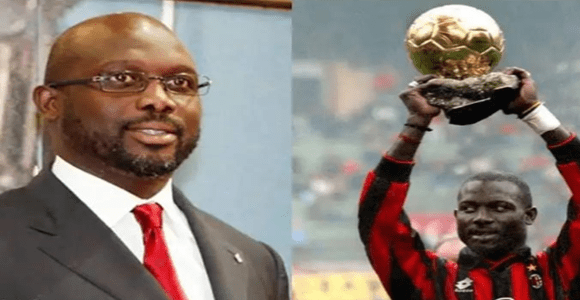
In December 1995, Weah became the first (and still only) African to win the Ballon d’Or and FIFA World Player of the Year. He also claimed his third African Player of the Year award. Moments like his solo goal against Verona for Milan later epitomized his genius. PSG’s success under his influence elevated French football’s profile.
AC Milan: Serie A Mastery and European Icon Status
Weah transferred to AC Milan in 1995, joining a star-studded squad. In five seasons, he scored regularly despite strong competition, helping win two Serie A titles (1996, 1999) and the 1996 UEFA Super Cup. His iconic long solo run and goal against Verona in 1996 remains one of football’s greatest.
In Serie A’s tough, tactical environment, Weah’s power, technique, and intelligence shone. He formed lethal partnerships and earned universal respect. Later brief spells at Chelsea (loan, FA Cup winner), Manchester City, Marseille, and Al-Jazira rounded out his career. He retired in 2003 with over 190 club goals.
International Career: Liberia’s Lone Star and Symbol of Hope
Weah earned 75 caps for Liberia (1988–2003), scoring 18 goals. Despite Liberia’s limited resources and civil wars, he almost single-handedly carried the team, qualifying them close to major tournaments and inspiring national pride. He played with passion, often funding aspects of the national team himself. Though he never played in a World Cup or AFCON final, his dedication made him Liberia’s greatest sporting icon.
Post-Playing Career: Politics, Presidency, and Public Service
After retiring, Weah entered politics as a UN Goodwill Ambassador. He founded the Congress for Democratic Change party, won a Senate seat in 2014, and was elected President of Liberia in 2017, taking office in 2018 as the first former professional footballer to become a head of state. He served until 2024, focusing on infrastructure, education, and reconciliation after civil war.
Playing Style and Personal Qualities
Weah was a complete forward: explosive speed, powerful shooting with both feet, exceptional dribbling in tight spaces, aerial ability, and vision. He combined physical dominance with elegance and joy. Off the pitch, his humility, philanthropy, and leadership earned admiration from peers like Pelé and Nelson Mandela.
Legacy: Why George Weah Transcends Current Stars
Weah won league titles in France and Italy, multiple domestic cups, the Ballon d’Or, FIFA World Player of the Year, and three African Player of the Year awards. He scored more goals and played more matches in Europe than any previous African professional.
Compared to modern forwards: Mbappé’s pace or Haaland’s finishing draw parallels, yet Weah achieved historic individual honors while playing for a small African nation with far less support, money, or protection. His seamless transition to national leadership adds a unique dimension few athletes match.
George Weah rose from Monrovia’s slums to global football immortality and presidential office. From barefoot street games to Ballon d’Or glory and leading his war-torn country, “King George” embodies resilience, excellence, and service. The only African to conquer the football world remains an eternal inspiration — proof that talent and determination can overcome any obstacle. His crown as Africa’s greatest player shines undimmed.