Introduction: Legendary Icon vs. Modern Stars
Samuel Eto’o Fils is one of the greatest African footballers ever and a forward who combined explosive pace, clinical finishing, aerial power, and fierce competitiveness. The Cameroonian striker conquered Europe with tenacity and skill during an era of intense physical defending and tactical evolution. While today’s stars like Erling Haaland, Kylian Mbappé, or Victor Osimhen benefit from advanced sports science, multimillion contracts, and specialized tactical systems, Eto’o thrived through raw determination, work rate, and big-game mentality while carrying the hopes of an entire continent. He won three consecutive La Liga titles with Barcelona (including the 2009 treble), a Champions League with Inter Milan in 2010, multiple African Player of the Year awards, and led Cameroon to Olympic gold and AFCON glory. This post traces his timeline: humble Douala beginnings, meteoric growth, European conquest, international heroism, and a legacy as Africa’s ultimate winner. Early Life: Douala Slums, Poverty, and Unyielding Determination
Samuel Eto’o was born on March 10, 1981, in Douala, Cameroon’s largest city. Raised in the tough Nkong Nsap neighborhood by a single mother after his parents separated, he grew up in modest conditions alongside several siblings. Football became his escape and obsession from a very young age.
Young Samuel played barefoot on dusty pitches and streets, developing exceptional speed, balance, and goal-scoring instinct. He joined local club Kadji Sports Academy, where his talent quickly stood out. Unlike modern academy prospects with luxury facilities and nutritionists, Eto’o’s early development was forged in hardship, street football, and raw hunger. At just 15, he moved to Spain to pursue a professional career, a bold and risky decision that tested his resilience.
Youth Development and Real Madrid Arrival: The Teenage Gamble
In 1997, at age 16, Eto’o joined Real Madrid’s youth system after impressing on trial. He faced significant challenges: cultural adjustment, racism, and limited first-team opportunities behind established stars. He made his senior debut in 1998 but was loaned out multiple times (Leganés, Espanyol, Mallorca) to gain experience.
These loan spells were crucial. At Mallorca (2000–2004), Eto’o truly exploded, scoring consistently in La Liga and winning the Copa del Rey in 2003. His growth from raw talent to polished striker showcased his work ethic, adaptability, and mental strength in a foreign environment.
Mallorca Breakthrough and Move to Barcelona: The Star Emerges
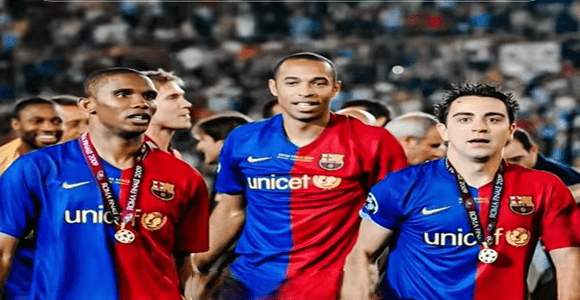
Eto’o’s performances at Mallorca earned him a €12 million move to FC Barcelona in 2004. Under Frank Rijkaard, he formed a deadly attacking trio with Ronaldinho and Deco. In six seasons (2004–2009), he scored 108 league goals in 145 appearances, winning three La Liga titles (2005, 2006, 2009) and the 2006 Champions League.
The 2008–09 season was historic: Barcelona achieved the treble (La Liga, Copa del Rey, Champions League), with Eto’o scoring in the Champions League final against Manchester United. His pace on the counter-attack and ability to score in big matches made him indispensable. He won African Player of the Year in 2003, 2004, 2005, and 2010.
Inter Milan and the 2010 Treble: Completing European Dominance
In 2009, Eto’o was part of the swap deal that brought Zlatan Ibrahimović to Barcelona and moved him to Inter Milan. Under José Mourinho, he adapted brilliantly to a new system. In 2009–10, Inter achieved the treble: Serie A, Coppa Italia, and Champions League (beating Bayern Munich 2–0 in the final, with Eto’o playing a key role). This made Eto’o one of the few players to win consecutive trebles with different clubs. His professionalism and leadership in Milan’s dressing room earned widespread respect.
Later Club Career: Russia, Turkey, Qatar, and India
Eto’o continued his nomadic but successful journey: Anzhi Makhachkala (Russia, 2011–2013), Chelsea (brief but impactful 2013–14 Premier League and Champions League winner), Everton, Sampdoria, Antalyaspor (Turkey), Konyaspor, and Qatar clubs. Even in his 30s, he maintained high scoring rates and leadership. He retired in 2018 after a stint with Qatar SC. Across his career, he scored over 350 official goals and won league titles in Spain, Italy, and elsewhere.
International Career: Cameroon’s Hero and Record Breaker
Eto’o earned 118 caps for Cameroon, scoring a record 56 goals. He won the Africa Cup of Nations in 2000 and 2002 (top scorer and best player in 2002), Olympic gold in 2000, and multiple other honors. He participated in four World Cups (1998–2014) and captained the Indomitable Lions with pride and passion. His commitment to Cameroon, often playing through injury and advocating for better conditions for African players, cemented his status as a continental icon.
Playing Style and Personality
Eto’o was a complete striker: explosive acceleration, powerful shooting with both feet, aerial dominance, intelligent movement, and tireless pressing. He combined physicality with technique and mental toughness. Known for his strong personality, outspoken views on racism and African football, and dedication to family and community, he has remained influential post-retirement.
Post-Playing Life and Legacy
After retirement, Eto’o entered football administration, becoming President of the Cameroonian Football Federation (FECAFOOT) in 2021. He continues advocating for African football development and player rights.
Legacy: Why Samuel Eto’o Transcends Current Stars
Eto’o won 3 La Liga titles, 1 Serie A, 3 Champions Leagues, 2 AFCON titles, Olympic gold, multiple African Player of the Year awards, and countless domestic cups. He is Cameroon’s and Africa’s all-time leading goalscorer in major competitions.
Compared to modern forwards: Haaland’s finishing or Mbappé’s pace echo elements of his game, yet few have matched Eto’o’s ability to win major trophies across multiple top leagues, deliver in consecutive trebles, and carry a national team while fighting systemic challenges in African football. In a more physically demanding and less protected era, his longevity and success remain remarkable.
Samuel Eto’o rose from the slums of Douala to conquer Europe and become an African legend. From teenage pioneer in Spain to treble winner with two clubs, Olympic champion, and national hero, “The Lion” embodied power, pride, and perseverance. His journey continues to inspire millions across Africa and beyond, proving that true greatness comes from heart, hunger, and relentless ambition. The King of African football reigns eternal.