Introduction: Legendary Icon vs. Modern Stars
Didier Drogba is one of the most iconic African footballers and one of the greatest strikers of the Premier League era. A powerful, charismatic No. 9 with exceptional aerial ability, clinical finishing, leadership, and clutch big-game performances, he thrived in an era of intense physical defending and transitional football. While today’s stars like Erling Haaland, Romelu Lukaku, or Victor Osimhen benefit from elite academies, data-driven training, and heavy squad rotation, Drogba succeeded through raw power, mental toughness, and an uncanny ability to deliver in decisive moments. He transformed Chelsea into Premier League champions, scored the winning penalty in the 2012 Champions League final, captained Ivory Coast through turbulent times, and became a national hero and philanthropist. This post traces his timeline: Ivorian beginnings, French development, explosive professional career, international leadership, and an enduring legacy as one of Africa’s greatest exports.
**Early Life: Abidjan to France – A Turbulent Childhood**
Didier Yves Drogba Téba was born on March 11, 1978, in Abidjan, Ivory Coast. The son of a bank employee and a seamstress, he moved to France at age five to live with an uncle after his parents struggled financially. He faced cultural adjustment, family separation, and the challenges of immigrant life in the suburbs of Paris and later Brest and Angoulême.
Young Didier played street football and for local clubs. Football became his anchor amid instability. He joined a small club in Abidjan before returning to France permanently. Unlike many modern strikers groomed in top academies from childhood, Drogba’s early years built resilience, humility, and a deep connection to his Ivorian roots. He often credits these hardships for shaping his fighting spirit.
**Youth and Early Professional Career: Le Mans and Guingamp – The Late Bloomer**
Drogba joined Le Mans in 1998 at age 20 as a semi-professional. He spent four seasons there, gradually developing his physique and technique in Ligue 2. In 2002, he moved to En Avant Guingamp in Ligue 1, where he finally exploded: 17 goals in the 2002–03 season made him one of the league’s standout performers.
These years were crucial for his growth. Coaches helped refine his hold-up play, aerial prowess, and movement. At 25, many considered him a late developer, but his maturity and work ethic set him apart. His performances earned him a dream move to Olympique de Marseille in 2003.
**Marseille Breakthrough: French Stardom and Champions League Impact**
At Marseille, Drogba became a superstar. In the 2003–04 season, he scored 19 league goals and led the team to the UEFA Champions League final (lost 2–0 to Porto). His powerful running, link-up play, and leadership transformed Marseille into contenders. He won the Ligue 1 Player of the Year award and finished second in the 2004 Ballon d’Or voting.
This period showcased his complete striker profile: physical dominance, technical improvement, and mental strength under pressure. It also caught the eye of Chelsea’s new owner Roman Abramovich.
**Chelsea Arrival and Premier League Dominance (2004–2012)**
In summer 2004, Drogba joined Chelsea for £24 million. Under José Mourinho, he became the spearhead of a new era. In his first season, he scored 10 Premier League goals and helped win the 2004–05 title — Chelsea’s first in 50 years. He followed with consistent excellence, winning Premier League titles in 2005–06, 2009–10, and 2014–15.
Drogba scored 164 goals in 381 appearances for Chelsea, including many iconic moments. He formed legendary partnerships with players like Frank Lampard and John Terry. His hold-up play, back-to-goal ability, and heading made him the ultimate target man. Despite occasional criticism for diving, his work rate and leadership were unmatched.
**The 2012 Champions League Final: Immortal Glory**
The pinnacle came on May 19, 2012, in Munich. With Chelsea trailing Bayern Munich, Drogba equalized with a powerful header in the 88th minute. He then scored the decisive penalty in the shoot-out, securing Chelsea’s first-ever Champions League title. This moment cemented his status as a club legend and one of football’s greatest clutch performers.
**International Career: Ivory Coast Captain and National Hero**
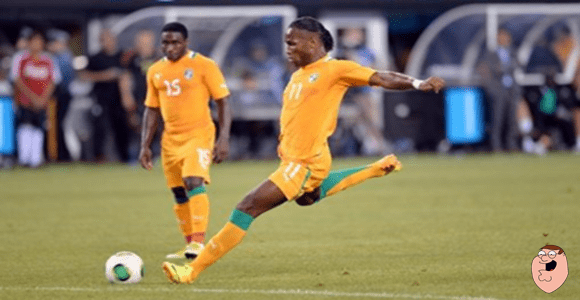
Drogba earned 104 caps for Ivory Coast, scoring 65 goals. As captain, he led the “Elephants” to three Africa Cup of Nations finals (2006, 2012, 2015 — reaching the final twice) and multiple World Cup appearances (2006, 2010, 2014). Though he never won the AFCON, his leadership during civil war times helped unite the country. In 2007, he famously appealed for peace on national television after a qualifier, an act that earned global admiration.
**Later Career: Galatasaray, Montreal, and Retirement**
After leaving Chelsea in 2012, Drogba enjoyed success at Galatasaray (Turkish league and cup), returned briefly to Chelsea (2014–15 Premier League title), then played in MLS with Montreal Impact and Phoenix Rising, where he also served as player-owner. He retired in 2018 at age 40.
**Playing Style and Personality**
Drogba was the ultimate modern target man: powerful physique, explosive pace for his size, brilliant heading, strong finishing with both feet, and exceptional leadership. He thrived on physical battles and rose to the biggest occasions. Off the pitch, his charisma, philanthropy (especially the Didier Drogba Foundation for healthcare and education in Africa), and humility made him a global ambassador.
**Post-Playing Life and Influence**
Since retirement, Drogba has remained active in football administration, business, and humanitarian work. He has been linked with roles at Chelsea and continues to inspire young African players.
**Legacy: Why Drogba Transcends Current Stars**
Drogba won 4 Premier League titles, 1 Champions League, 2 League Cups, Turkish and French domestic honors, and countless individual awards including multiple African Player of the Year recognitions. He scored 105 goals in 254 Premier League appearances and delivered unforgettable moments for club and country.
Compared to modern strikers: Haaland’s goal-scoring efficiency or Lukaku’s power draw comparisons, yet few match Drogba’s ability to elevate teams, score in cup finals, unite nations, and succeed across continents while carrying the weight of expectation from a war-torn homeland. In a more physical, less protected era, his longevity and clutch performances stand out.
Didier Drogba rose from the streets of Abidjan and French suburbs to conquer Europe and inspire a continent. From late-blooming prospect to Champions League hero and national unifier, “The Dragon” embodied power, passion, and purpose. His journey remains a blueprint for African football excellence and proves that true legends are defined not just by goals, but by moments that transcend the pitch. The African King’s roar still echoes across Stamford Bridge and beyond.