Introduction: Legendary Icon vs. Modern Stars
Xavier “Xavi” Hernández Creus is one of football’s greatest midfielders and a defining figure of the modern possession-based game. With exceptional vision, precise passing, tactical intelligence, and leadership, he orchestrated Barcelona’s golden era and Spain’s historic dominance. While today’s stars like Kevin De Bruyne, Rodri, or Toni Kroos impress with progressive passes, long-range vision, and physical presence supported by analytics and high-pressing systems, Xavi thrived through spatial awareness, tempo control, and simplicity in an era when tiki-taka revolutionized football. He won 25 major trophies with Barcelona (including 8 La Liga titles and 4 Champions Leagues), captained Spain to the 2010 World Cup and two European Championships, and later succeeded as a coach. This post traces his timeline: Catalan roots, La Masia forging, professional ascent, peak dominance, later years, and an enduring legacy as the ultimate midfield conductor.
**Early Life: Terrassa, Family, and Early Passion**
Xavi Hernández was born on January 25, 1980, in Terrassa, a city near Barcelona in Catalonia, Spain. The youngest of three brothers in a football-mad family, his father Joaquim and brother Óscar both played at lower levels. Young Xavi joined local club CD Terrassa and quickly stood out for his understanding of the game rather than raw athleticism.
At age 11 in 1991, he joined FC Barcelona’s famous La Masia academy after impressing at a youth tournament. The move required daily travel and immense dedication. Unlike many modern academy prospects with luxurious facilities from a young age, Xavi’s early development emphasized technical purity, positional play, and the famous La Masia philosophy of “control the ball, control the game.” His slight frame was never an obstacle; coaches recognized his football brain immediately.
**La Masia Development: Shaping the Midfield Maestro**
At La Masia, Xavi progressed through the ranks alongside players like Andrés Iniesta, Cesc Fàbregas, and Gerard Piqué. He absorbed lessons on short passing, movement off the ball, and maintaining possession under pressure. He captained several youth teams and won multiple academy titles.
By 1997–98, he was starring for Barcelona B in the Segunda División. His growth was steady and profound — coaches noted his ability to dictate tempo, find angles for passes, and make the game look simple. These years built not only technical excellence but also the humility and work ethic that defined his career.
**First-Team Breakthrough: Louis van Gaal and Early Struggles**
Xavi made his senior debut on August 18, 1998, at age 18, coming on as a substitute against Mallorca. Under Louis van Gaal, he gradually earned more playing time despite competition from established midfielders. He scored his first goal in 1998 and became a regular by the 2000–01 season.
Early challenges included injuries and adapting to the physicality of La Liga. However, his intelligence and consistency shone through. He contributed to Barcelona’s 1998–99 La Liga title and helped stabilize the midfield during transitional years.
**The Rijkaard Era and Rise to Prominence**
Frank Rijkaard’s arrival in 2003 marked a turning point. Xavi formed a formidable midfield partnership with Ronaldinho, Deco, and later Iniesta. Barcelona won La Liga in 2004–05 and 2005–06, plus the 2006 Champions League. Xavi’s role as the deep-lying playmaker — recycling possession, switching play, and controlling rhythm — became central to the team’s identity.
In over 766 La Liga appearances for Barcelona (1998–2015), he scored 85 goals while providing hundreds of assists. His leadership qualities emerged strongly during this period.
**Pep Guardiola Era: The Pinnacle of Tiki-Taka Mastery**
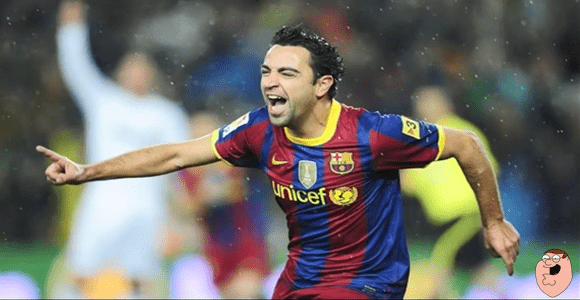
Pep Guardiola’s appointment in 2008 propelled Xavi to legendary status. As captain from 2011 (after Carles Puyol), he was the on-pitch architect of Barcelona’s greatest team. The club achieved the 2009 treble, another Champions League in 2011, and multiple domestic titles. Xavi’s ability to find space in congested areas, deliver perfect weighted passes, and maintain composure under intense pressing was unparalleled.
Iconic moments include his performances in Champions League finals and El Clásicos. Alongside Iniesta and Busquets, he formed arguably the greatest midfield trio in football history. Xavi won multiple UEFA Midfielder of the Year awards and finished high in Ballon d’Or voting.
**International Career: Spain’s Golden Generation Leader**
Xavi debuted for Spain in 2000 and became a cornerstone of the golden era. Spain won Euro 2008 (his vision key in the final), the 2010 World Cup in South Africa, and Euro 2012. He played 133 caps, scoring 13 goals, and provided crucial assists, including in major finals.
At the 2010 World Cup, his experience and calm guidance helped Spain overcome tough opponents. Xavi retired from internationals after the 2014 World Cup, having transformed Spain from underachievers to the dominant force of the era.
**Later Barcelona Years and Move to Al-Sadd**
Xavi remained loyal to Barcelona until 2015, winning his final trophies under various coaches. At age 35, he joined Qatar’s Al-Sadd, where he played from 2015 to 2019, winning multiple domestic titles and the 2019 AFC Champions League. He served as player-coach in his final season, scoring and assisting regularly while transitioning to management.
**Coaching Career and Return to Barcelona**
After retiring as a player in 2019, Xavi managed Al-Sadd successfully before returning to Barcelona as head coach in November 2021. Despite financial constraints, he implemented a possession-based style reminiscent of his playing days, winning La Liga in 2022–23 and several domestic honors. He left in 2024 but remains closely linked to the club’s philosophy.
**Playing Style and Personal Attributes**
Xavi’s game was defined by metronomic passing accuracy (often above 90%), positional intelligence, leadership, and stamina. He rarely lost possession and made teammates better through movement and vision. Off the pitch, his humility, professionalism, and deep football knowledge earned universal respect.
**Legacy: Why Xavi Transcends Current Stars**
Xavi won 8 La Liga titles, 4 Champions Leagues, 3 Club World Cups, 2 Euros, 1 World Cup, and numerous domestic cups — totaling 25 major honors at club level plus international triumphs. He made over 900 senior appearances with strong goal and assist contributions. He is widely regarded as one of the best central midfielders ever and a FIFA 100 member.
Compared to modern midfielders: De Bruyne’s creativity or Rodri’s defensive solidity draw comparisons, yet few matched Xavi’s longevity at the absolute highest level, his role in defining an entire playing philosophy, and his success in both playing and coaching the same system. He succeeded without relying on physical dominance or set-piece specialization in an increasingly athletic game.
Xavi Hernández didn’t just play football — he conducted it like a symphony. From the streets of Terrassa to La Masia, Camp Nou triumphs, and global glory with Spain, “The Architect” exemplified intelligence, loyalty, and beautiful simplicity. His influence on modern football remains profound, proving that vision and control can conquer raw power. The maestro’s legacy continues to shape the beautiful game.