**The Khan Who Ran**
### The Moment of Emptiness
There was a moment—though no chronicler recorded it, and no court poet thought to mark it—when Hulagu Khan stood at the edge of a high desert plateau and felt, for the first time in his life, the peculiar emptiness that follows the completion of every great ambition.
He had spent decades building roads, organizing cities, supporting scholars, and overseeing one of the largest realms of his age. His name was known across mountains, deserts, and distant trade routes. Messengers carried his decrees from one horizon to another. By every measure available to his contemporaries, he had succeeded.
And yet the plateau was silent. The wind moved across the stone without urgency. The sky stretched above him, vast and indifferent. Hulagu Khan, surrounded by everything he had spent a lifetime creating, found himself uncertain of what should come next. Success, he discovered, was a destination with no map.
### The Weight of Years
His body carried the record of a life spent outdoors. Long days on horseback, endless journeys across rough country, and countless seasons beneath sun and wind had shaped him into a man of unusual strength. Even in his sixties he could lift what younger men struggled to move and could spend entire days traveling while arriving with energy to spare.
But strength and vitality are not the same thing. A thoughtful physician in Tabriz noticed that the Khan often complained of stiffness in his legs and restlessness during long meetings.
“The body was made for motion,” the physician told him. “For many years your horse carried you across the world. Perhaps now it is time to cross some of it yourself.”
Hulagu dismissed the suggestion at first. Then he thought about it for three weeks.
### The First Run
One morning before dawn, while the city still slept, he left the palace in simple clothing and walked beyond the walls. The air was cool. The roads were empty. He walked for a while, then began to run.
It was not graceful. His stride was heavy, and his breathing quickly became uneven. Within a short distance he stopped beside a rock, hands on his knees, wondering why anyone would choose to do this voluntarily.
Yet the next morning he returned. And the morning after that. Within weeks he could cover distances that had once seemed impossible. The stiffness in his legs began to ease. His breathing grew steady. His movements became lighter. The effort that had once exhausted him became a source of energy.
Without intending to, Hulagu Khan became a runner.
### The Journey South
The decision to travel south came not from necessity but from curiosity. For much of his life every journey had a purpose: administration, diplomacy, inspection, or ceremony. This one had none.
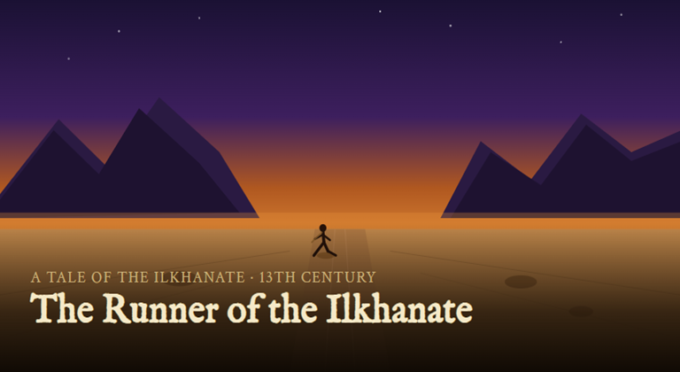
He travelled with a small group—a physician, a guide, and a few attendants who understood the value of silence. Together they moved toward the great desert. There, Hulagu discovered a different kind of challenge. The dunes demanded balance. The rocky plateaus demanded patience. The dry air demanded discipline.
Every mile became a conversation between body and landscape. He ran in the cool hours before sunrise and walked beneath the evening sky. He followed forgotten paths connecting wells and oases, crossed salt flats that shimmered beneath the heat, and climbed sandstone ridges to watch the dawn spread across the desert floor.
For the first time in many years, he was not traveling toward a destination. He was simply moving.
### What the Desert Teaches
The desert taught lessons that no court scholar could explain. It taught economy of effort, patience, and attention. Running across open ground, Hulagu began to notice details he had once overlooked: the shape of footprints in sand, the changing color of stone at sunset, and the subtle differences between morning winds and evening winds.
The farther he travelled, the less he felt the need to hurry. His strength remained, but it changed in character. It was no longer the strength of force. It became the strength of endurance. He learned to trust his breath, the rhythm of his stride, and the difference between moving quickly and moving well.
### The Return
After many weeks he returned to Tabriz. Those who knew him immediately noticed something different. He had grown leaner, more relaxed, and more attentive. Most surprising of all, he continued running.
Every morning before the day’s responsibilities began, Hulagu Khan set out along the roads beyond the city. Over time he learned every hill, every stream, and every stand of trees within a day’s journey. Officials who expected to meet him in a palace occasionally found him arriving on foot after a morning run—cheerful, energetic, and ready to discuss matters of state. Some of them eventually began running as well.
### What Was Remembered
The official histories recorded laws, buildings, trade routes, and successions. They did not record the quiet mornings, the desert roads, or the aging ruler who discovered, late in life, that movement itself could be a form of freedom.
Yet stories travel in unexpected ways. For generations people spoke of a Khan who loved long distances, who explored old roads simply to see where they led, and who found joy in crossing landscapes under his own power.
Whether every detail was true no longer mattered. What remained was the image of a strong man who spent much of his life building a world around him and the final part of his life discovering the world beneath his own feet.
He ran because there was always another horizon. He ran because strength grows when it is used. He ran because movement brought clarity. And he ran because, after everything else had been accomplished, there was still one journey left to make.