Introduction: Legendary Icon vs. Modern Stars
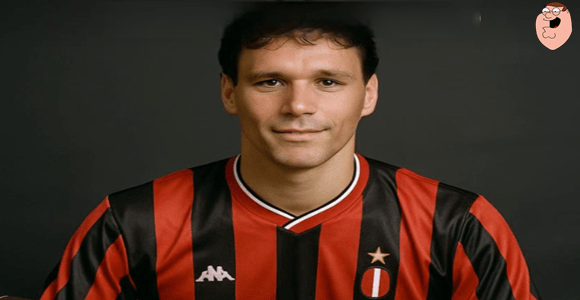
Marco van Basten is widely regarded as one of the purest, most complete strikers football has ever seen. The Dutch forward combined elegance, clinical finishing, aerial dominance, and spectacular technique in a way that made goals look like art. While today’s stars like Erling Haaland, Harry Kane, or Robert Lewandowski dominate through athletic power, pressing intensity, and data-optimized movement, van Basten operated with balletic grace and intelligence in an era of tighter marking and more physical duels. He won three Ballon d’Or awards (1988, 1989, 1992), led the Netherlands to Euro 1988 glory with an iconic volley, and powered AC Milan’s late-1980s/early-1990s dominance. Yet his career was tragically cut short by a recurring ankle injury, with his last competitive match at age 28. This post traces his timeline: Utrecht beginnings, rapid rise, peak excellence, and bittersweet legacy.
**Early Life: Utrecht Roots and a Natural Gift**
Marcel “Marco” van Basten was born on October 31, 1964, in Utrecht, Netherlands, in the Oog in Al neighborhood. His father, Joop, was a semi-professional footballer and coach who nurtured his son’s talent from an early age. Young Marco began kicking a ball around age two and joined local club EDO at six.
He progressed through UVV Utrecht and then USV Elinkwijk, where his prodigious scoring and technique stood out. Unlike modern academy systems with specialized coaching and sports science from childhood, van Basten’s early development blended street football, local clubs, and natural intuition. His tall, athletic frame (eventually around 188 cm) paired with exceptional balance, close control, and timing made him a standout by his early teens.
**Youth Development and Ajax Breakthrough: The Prodigy Emerges**
Ajax spotted van Basten and brought him into their renowned youth academy in 1981 at age 16–17. He made his senior debut on April 3, 1982, at age 17, scoring in a 5–0 win. The following seasons saw him explode: he became Eredivisie top scorer for four consecutive years (1983–84 to 1986–87), netting remarkable tallies like 28 goals in 1985–86.
In 133 league appearances for Ajax, he scored 128 goals — an astonishing ratio. He helped the club win three Eredivisie titles (1981–82, 1982–83, 1984–85), three KNVB Cups, and the 1987 European Cup Winners’ Cup. Van Basten formed a potent attack alongside players like Johan Cruyff’s influence in the club’s philosophy, developing into a complete centre-forward: lethal in the box, strong in the air, and capable of breathtaking volleys and acrobatic finishes.
His growth was fueled by Ajax’s technical emphasis, but also by the physical demands of Dutch football, building the resilience that defined his early peak.
**International Arrival and Euro 1988 Glory: The Swan Takes Flight**
Van Basten debuted for the Netherlands in 1983. Though the team missed the 1986 World Cup, Euro 1988 in West Germany became his immortal stage. As part of a golden generation with Ruud Gullit and Frank Rijkaard, he scored five goals, including a hat-trick against England and the tournament-winning volley in the final against the Soviet Union — a stunning strike from a tight angle widely considered one of football’s greatest goals.
The Netherlands lifted their first major trophy, with van Basten earning the Golden Boot and Player of the Tournament. In 58 caps, he scored 24 goals. This triumph, combined with domestic and European success, propelled him to his first Ballon d’Or in 1988.
**AC Milan Transfer and Serie A Domination: Partnership with the Dutch Trio**
In 1987, van Basten joined AC Milan for a significant fee, reuniting with compatriots Gullit and Rijkaard under visionary coach Arrigo Sacchi. Despite missing much of his first season with an ankle injury, he helped Milan win the 1987–88 Serie A title.
At full fitness, he became the spearhead of Milan’s pressing, zonal-marking masterpiece. In 147 Serie A appearances, he scored 90 goals. The team secured back-to-back European Cups in 1989 and 1990 (van Basten scored twice in the 1989 final), plus three more Serie A titles (1988, 1992, 1993). Milan’s 58-match unbeaten league run highlighted their supremacy.
Van Basten’s intelligence — timing runs, link-up play, and finishing with either foot or head — made him nearly unmarkable. He won Ballon d’Or awards in 1989 and 1992, plus the 1992 FIFA World Player of the Year.
**The Injury Nightmare and Premature End**
A recurring right ankle injury, stemming from a clash in 1986 and worsening over years, plagued his later Milan years. Multiple surgeries failed to resolve the issue fully. He played sparingly after 1992 and made his final appearance in 1993. Officially retiring in August 1995 at age 30, his elite career spanned barely a decade.
The tragedy lies in the “what if”: many believe a fully fit van Basten could have shattered more records and extended his prime into the mid-1990s.
**Post-Playing Career: Coaching and Reflection**
After retirement, van Basten transitioned to coaching. He managed Ajax (2004–2008, winning the KNVB Cup) and the Netherlands national team (2004–2008), reaching the Euro 2008 quarter-finals with an attractive style. Later roles included Heerenveen and AZ Alkmaar. Health challenges and stylistic differences sometimes limited his managerial success, but he remained influential in Dutch football.
**Legacy: Why van Basten Transcends Current Stars**
Van Basten’s club totals stand at roughly 280 league appearances and 218 goals, with overall career figures nearing 300+ goals in under 400 senior matches. His efficiency, combined with three Ballon d’Ors and iconic moments, cements his place among the all-time greats.
Compared to modern strikers: Haaland’s raw power or Kane’s all-round game draw stylistic parallels, yet few match van Basten’s aesthetic perfection and versatility in the box. He excelled without today’s heavy squad rotation, advanced recovery, or tactical freedom of false 9s. In a more physical, less protective era, his technique and timing shone brighter.
Often called the greatest pure striker by connoisseurs, van Basten’s career embodies football’s poetry and fragility. The Swan of Utrecht flew supremely but briefly, leaving an indelible image of elegance and what might have been. His goals remain timeless reminders that true greatness can be measured in quality as much as quantity.