Introduction: Legendary Icon vs. Modern Stars
Diego Armando Maradona stands as football’s ultimate symbol of raw genius, resilience, and human complexity. The Argentine maestro possessed unmatched close control, vision, balance, and an almost supernatural ability to dominate games single-handedly. While today’s stars like Lionel Messi, Neymar, or Kylian Mbappé benefit from advanced training, medical support, tactical frameworks, and global commercial empires, Maradona thrived — and sometimes faltered — in a grittier era of brutal defending, limited protections, and intense personal pressures. He captained Argentina to the 1986 World Cup, transformed Napoli into Italian champions, and delivered moments of pure magic like the “Goal of the Century.” This post traces his timeline: poverty-stricken beginnings, explosive growth, professional triumphs and controversies, and a legacy that continues to captivate the world.
**Early Life: Villa Fiorito, Poverty, and a Footballing Escape**
Diego Maradona was born on October 30, 1960, in Lanús, Buenos Aires Province, Argentina, and raised in the humble shantytown of Villa Fiorito. The fifth of eight children in a working-class family that had migrated from Corrientes, he grew up in extreme poverty. His father worked in a meat-packing factory, and the family often struggled for basic necessities.
Football became young Diego’s refuge. He played with a makeshift ball made of rags on dirt pitches, developing extraordinary touch and dribbling skills. At age eight, he was spotted while playing for a local side called Estrella Roja. A talent scout recommended him to Argentinos Juniors’ youth academy, *Los Cebollitas* (“The Little Onions”), where coach Francisco Cornejo nurtured his prodigious talent. Maradona’s family received support from the club, including help with housing, highlighting his early importance.
Unlike modern academy stars with nutritionists and psychologists from a young age, Maradona’s development was forged in street football and raw survival instincts. His low center of gravity, lightning acceleration, and vision set him apart immediately.
**Youth Development and Professional Debut: A Teenager’s Rise**
Maradona made his senior debut for Argentinos Juniors on October 20, 1976 — just 10 days before his 16th birthday — becoming one of the youngest players in Argentine Primera División history. He scored his first goal soon after and quickly became the league’s standout performer.
Over five seasons (1976–1981), he scored 116 goals in 166 appearances, showcasing maturity beyond his years. In 1979, he captained Argentina to the FIFA U-20 World Cup title, scoring in the final and announcing himself as a global prospect. His nickname “El Pibe de Oro” (The Golden Boy) was already fitting.
This period built not only technical mastery but mental toughness. He carried the hopes of his family and neighborhood while facing the physicality of senior football with minimal referee protection.
**Boca Juniors and First Taste of Glory**
In 1981, Maradona transferred to Boca Juniors, fulfilling a boyhood dream. In his single full season (1981 Metropolitano), he scored 28 goals in 40 appearances and helped secure the Argentine Primera División title. His performances featured trademark dribbles, vision, and leadership that electrified La Bombonera.
The move marked his transition from promising talent to national hero. However, the pull of Europe soon proved irresistible.
**Barcelona: World Record Transfer and Turbulent Adaptation**
In 1982, Maradona joined FC Barcelona for a world-record £5 million fee. He made an immediate impact but faced challenges: a hepatitis bout, injuries, and clashes with management. In 58 appearances, he scored 38 goals, winning the Copa del Rey in 1983 and the Spanish Super Cup.
A notorious quarter-final brawl in the 1984 Copa del Rey against Athletic Bilbao saw him involved in a mass confrontation. Despite flashes of brilliance, his time in Spain was marred by physical wear and off-field issues. The stage was set for his defining chapter.
**Napoli: The Divine Savior of a City**
In 1984, Maradona moved to Napoli for another world-record £6.9 million. What followed was football alchemy. He transformed a modest southern Italian club, long overshadowed by northern giants, into Serie A champions in 1987 and 1990 — their only two titles. He also won the Coppa Italia (1987), UEFA Cup (1989), and Italian Super Cup.
In 259 appearances, he scored 115 goals while providing countless assists. Maradona became a demi-god in Naples. Fans saw him as a symbol of resistance against inequality. His dribbling through packed defenses, pinpoint passes, and clutch performances defined an era. Yet fame brought intense scrutiny and personal struggles with addiction.
**International Stardom: The 1986 World Cup Immortal**
Maradona debuted for Argentina in 1977 at 16. After a disappointing 1982 World Cup, 1986 in Mexico became his masterpiece. As captain, he scored 5 goals and provided 5 assists in 7 games — directly involved in 10 of Argentina’s 14 goals.
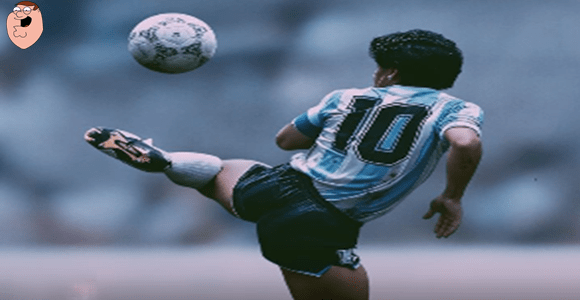
The quarter-final against England produced two of football’s most iconic moments: the controversial “Hand of God” goal and, minutes later, the “Goal of the Century” — a 60-meter dribble past five English players. Argentina beat West Germany 3–2 in the final, with Maradona assisting the winner. He won the Golden Ball as tournament’s best player.
In 1990, he led an injury-depleted side to the final (runner-up to Germany). Across 91 caps, he scored 34 goals, cementing his status as Argentina’s greatest.
**Later Club Career: Wanderings and Final Flashes**
A 15-month ban for cocaine in 1991 ended his Napoli dominance. Brief spells followed: Sevilla (1992–93), Newell’s Old Boys (1993–94), and a return to Boca Juniors (1995–97), where he showed occasional brilliance before retiring in 1997 at 37.
Injuries, suspensions (including a 1994 World Cup ban), and health battles marked these years, yet his aura endured.
**Post-Playing Life, Coaching, and Passing**
Maradona transitioned into coaching with mixed results, including managing Argentina at the 2010 World Cup. He remained a global icon, pundit, and beloved figure despite ongoing personal struggles. He passed away on November 25, 2020, at age 60, triggering worldwide mourning. His legacy lives through the Diego Maradona Foundation and endless tributes.
**Legacy: Why Maradona Transcends Current Stars**
Maradona’s career totals: 490 official club games with 259 goals, plus 91 caps and 34 international goals. He won league titles in Argentina and Italy, major cups, and the ultimate World Cup glory almost single-handedly.
Compared to modern greats: Messi’s consistency and finishing or Mbappé’s athleticism awe fans, but few matched Maradona’s ability to drag average teams to glory against stronger opposition in a more physical, less forgiving era. He lacked today’s recovery protocols, squad rotation, or VAR yet produced unmatched moments of improvisation and leadership.
His story — from barrio slums to global deity, intertwined with triumph and tragedy — embodies football’s beauty and fragility. “El Diego” wasn’t perfect, but his genius was divine. In an age of polished superstars, Maradona reminds us that true legends are flawed, passionate, and capable of magic that defies statistics. The King of the People reigns eternal.