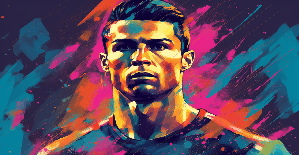
Cristiano Ronaldo: The Eternal Pursuit of 1,000
From the damp hillsides of Madeira to the floodlit arenas of Riyadh, one man rewrote every number football had ever known.
There is a number that has haunted football for decades, hovering at the edge of possibility like a distant summit no climber has ever reached: one thousand official career goals. Pelé and Romário have invoked it, adjusting tallies to include friendlies, testimonials, and games against regional select sides. But in the cold ledger of competitive football — league matches, cup ties, continental nights — no man has crossed that threshold. As of May 2026, Cristiano Ronaldo stands at 971, and the mountain is close enough to touch.
Early Life and Emergence in Portugal
Ronaldo grew up in a working-class family on the island of Madeira, the youngest of four children born to Maria Dolores and José Dinis Aveiro. Pocket money was scarce; ambition was not. He trained obsessively at local club CF Andorinha, then at CD Nacional, before Sporting CP’s recruiters spotted something elemental in his movement — not just pace or technique, but a competitive hunger that looked almost geological in its density. At twelve he left his mother and the Atlantic fog of Funchal for Lisbon, enduring homesickness and bullying over his Madeiran accent. He channelled both into training. By 2002, he was seventeen years old and already making his Primeira Liga debut. The island had produced something extraordinary, and continental Europe was about to notice.
Goals by Club — A Career in Numbers
Official competitive goals by club and country
First Spell at Manchester United (2003–2009)
When Sir Alex Ferguson paid Sporting CP £12.24 million for an eighteen-year-old in the summer of 2003, some eyebrows lifted in the Old Trafford stands. Ronaldo arrived as a winger of spectacular but untested promise — all stepovers and close control, brilliant in flashes but raw at the fundamental craft of professional football. Ferguson saw something beneath the showmanship. Over six seasons, he guided the boy from Madeira through a systematic reconstruction, from fleet-footed entertainer to one of the most complete forwards the European game had ever seen.
The transformation reached its apex in 2007–08, when Ronaldo scored 42 goals across all competitions, steered Manchester United to a Champions League triumph in Moscow, and collected his first Ballon d’Or — edging out Lionel Messi and Fernando Torres in what felt, at the time, like a coronation. He left Old Trafford in the summer of 2009 having won three Premier League titles, one Champions League, and an FA Cup, and having irrevocably changed the popular understanding of what an attacking wide player could be.
The Madrid Era — 450 Goals and Four Champions Leagues
The world record fee of €94 million announced Ronaldo’s arrival at Real Madrid with the kind of theatre he has always seemed to generate effortlessly. What followed across nine seasons was not merely prolific — it was statistically unprecedented. At the Santiago Bernabéu, with Karim Benzema and later Gareth Bale beside him, Ronaldo entered a phase of scoring so consistent and so voluminous that it strained credibility on a weekly basis.
“I’m motivated. My passion is still there. I want to win trophies and I want to reach that number. I will get there, if I stay healthy.”
— Cristiano Ronaldo, Globe Soccer Awards, 2026
He plundered La Liga’s single-season record with 61 goals in 2014–15, a figure arrived at through a combination of predatory instinct, obsessive preparation, and the physical conditioning of someone who treats his body as a precision instrument rather than a working tool. He scored 450 goals in 438 matches for the club — a ratio just above one per game that remains, in the context of a player operating at the highest level of club football, almost incomprehensible. Four Champions League medals, four Ballon d’Or awards, two La Liga titles: the decade belonged to him.
Goals scored per club era
Italy, Return, and the Saudi Chapter
His three seasons at Juventus were a study in individual excellence coexisting with collective limitation. The Bianconeri acquired Ronaldo in 2018 at a cost of €100 million seeking the Champions League trophy that had eluded them since 1996; they never came close. Yet Ronaldo himself was irrepressible, becoming the first player to reach 100 Champions League goals, delivering back-to-back Serie A titles, and maintaining the thirty-goal seasons that had come to seem almost contractual. When he returned briefly to Manchester United in 2021, he scored on debut and reached the milestone of 800 official career goals, a number that, when he first arrived in England eighteen years earlier, no one would have imagined possible.
The move to Al-Nassr in January 2023 was described by some as an exit from relevance. It has proved to be nothing of the sort. In the 2025–26 Saudi Pro League season alone, Ronaldo has contributed 28 goals, maintaining an average FotMob rating of 7.88 — numbers that, transposed to any European league, would make him a leading candidate for the Golden Boot. He has scored 127 goals in 146 games for the Riyadh club and, in January 2026, netted his landmark 100th Al-Nassr goal in the Saudi Super Cup final against Al Ahli. The league’s global visibility has transformed; when Ronaldo plays, the world still watches.
The Records That Remain
All-time records held as of May 2026
143 international goals — Portugal
140 Champions League goals
42 Champions League assists
226 Portugal caps
494 goals scored after age 30
5 Ballon d’Or awards
100+ goals for four different clubs
1,300+ official career appearances
The Anatomy of Longevity
Elite athletes decline. It is the one rule of sport that appeared, for decades, as close to inviolable as physics. Ronaldo has spent the better part of a decade treating it as a challenge rather than a certainty. The physiological baseline is documented and remarkable: body fat measured consistently below ten percent; a sleep protocol built around multiple ninety-minute cycles rather than a conventional eight-hour block; a diet from which almost all processed food, alcohol, and refined sugar have been eliminated for years. But the numbers alone cannot explain the persistence of desire. At forty-one, with five Ballon d’Or trophies in a cabinet and every meaningful record in the sport already bearing his name, what drives a man to keep scoring?
The answer, as Ronaldo has articulated it in various forms over the years, is the number. One thousand goals is not a round figure he invented for convenience — it is the one thing in football that has never been done, and the one thing that would place him beyond comparison. He has said he will not retire until he reaches it. His contract at Al-Nassr has been extended accordingly. Projections, based on his current scoring rate of roughly one goal every 93 minutes of Saudi Pro League football in 2025–26, suggest the milestone could fall in the early weeks of the 2026–27 season. Twenty-nine goals is not a vast distance. The question is no longer whether the number is possible — it is only whether time and fitness will hold.
International Captaincy and the Portugal Legacy
No player in men’s international football has ever scored more goals. Ronaldo’s 143 for Portugal, accumulated across 226 appearances spanning three decades of competitive football, stand as the definitive measure of longevity in the international game. He captained Portugal to their first major trophy at UEFA Euro 2016 — limping off with a knee injury in the final’s opening stages, returning to patrol the touchline in tracksuit and crutches, orchestrating and cajoling until Éder’s extra-time strike sealed the title. The image endures: the injured captain, unwilling to become a spectator at the defining moment of his country’s footballing history.
“From Madeira to 1,000 — no expiry date on greatness.”
— Editorial summary
Business, Brand, and a Life Beyond the Pitch
The commercial architecture Ronaldo has constructed around his playing career is, by any standard, extraordinary. His social media following — hundreds of millions across platforms — makes him not merely the most followed athlete on earth but one of the most followed human beings. The CR7 brand encompasses fragrance, underwear, hotels in Lisbon, Madeira, New York, and Madrid, and a gymnasium chain, all operated with the same methodical attention to marginal gains that characterises his physical preparation. Where other athletes have coasted on endorsement deals, Ronaldo has built vertically: he does not merely lend his name, he owns the infrastructure.
Away from the ledgers, he remains a devoted father to five children and has been consistently active in philanthropic causes, from children’s cancer wards to earthquake disaster relief in Morocco — a connection to North Africa that has only deepened since his move to the region’s neighbouring football landscape. He has donated blood platelets regularly for years, citing his late father as the reason he has never had a tattoo: a private, quiet tenderness inside the armour of the world’s most relentless competitor.
The GOAT Debate — and Why It May Not Matter
The parallel career of Lionel Messi has given Ronaldo’s story its most persistent dramatic tension. Two players, almost exactly contemporary, almost exactly matched in brilliance, reaching stratospheric heights in the same sport at the same time: it is the kind of coincidence that football historians will spend generations attempting to contextualise. Messi’s artistry — the low centre of gravity, the left foot’s casual witchcraft, the manner in which he appears to slow the game into something contemplative — contrasts so sharply with Ronaldo’s explosive, vertical, willed excellence that comparison becomes almost a category error.
What can be said without serious dispute is this: at forty-one, Ronaldo is still scoring goals in a professional league, still chasing records, still making the sport interesting. Whatever conclusion the GOAT debate eventually reaches — if it reaches one at all — Ronaldo’s story is not finished. The final chapter is still being written, one goal at a time, twenty-nine short of something no footballer has ever touched.