Introduction: Legendary Icon vs. Modern Stars
Ronaldinho Gaúcho, born Ronaldo de Assis Moreira, brought pure joy and magical improvisation back to football at the highest level. With his infectious smile, gravity-defying dribbling, no-look passes, thunderous free-kicks, and elastic skill, he turned matches into spectacles. While today’s stars like Neymar, Phil Foden, or Jamal Musiala dazzle with technical ability, athleticism, and tactical discipline supported by analytics and sports science, Ronaldinho thrived on creativity, unpredictability, and sheer fun in an era of intense physical marking. He won the 2005 Ballon d’Or, two FIFA World Player of the Year awards (2004, 2005), the 2002 World Cup with Brazil, and the 2006 Champions League with Barcelona. This post traces his timeline: Brazilian beginnings, explosive growth, professional peaks and later challenges, and a legacy as one of the game’s greatest entertainers.
**Early Life: Porto Alegre, Family Tragedy, and Street Magic**
Ronaldinho was born on March 21, 1980, in Porto Alegre, Rio Grande do Sul, Brazil. The youngest of three children, he grew up in a football-loving family. His father, João de Assis Moreira, was a shipyard worker and amateur footballer who died of a heart attack when Ronaldinho was just eight — a devastating blow that deeply affected him. His older brother Roberto Assis, a professional player, became a key mentor.
Young Ronaldo played futsal from age four and transitioned to outdoor football around seven. He honed his skills on the streets and futsal courts of Porto Alegre, developing incredible close control, balance, and imagination. The nickname “Ronaldinho” (Little Ronaldo) distinguished him from the earlier phenomenon Ronaldo Nazário. Unlike modern academy stars with structured programs, his early development relied on street creativity, family support, and raw Brazilian flair.
**Youth Development and Grêmio Breakthrough: The Teen Prodigy**
Ronaldinho joined Grêmio’s youth academy around age seven. He progressed rapidly, scoring all 23 goals in one youth match that drew media attention. He made his senior debut in 1998 at age 18 during the Copa Libertadores and quickly became a star. In 1999, still a teenager, he scored 22 goals in 47 appearances, helping Grêmio win the Campeonato Gaúcho and Copa Sul.
His audacious style — step-overs, rainbow flicks, and pinpoint crosses — made him a fan favorite. He represented Brazil at youth levels, winning the 1997 U-17 World Cup. At 20, Europe called, and he transferred to Paris Saint-Germain in 2001 for a significant fee.
**Paris Saint-Germain: European Adaptation and Rising Stardom**
At PSG (2001–2003), Ronaldinho adapted to European tactical rigor while retaining his flair. In 55 league appearances, he scored 17 goals, adding creativity and trickery that entertained Ligue 1 crowds. He won the 2001 UEFA Intertoto Cup and formed exciting partnerships, notably with Nicolas Anelka.
His performances at the 2002 World Cup elevated him further. Though not the main star, his contributions (including a memorable free-kick against England) helped Brazil secure their fifth title. This global exposure made him one of football’s most coveted talents.
**Barcelona: The Golden Years and Peak Magic (2003–2008)**
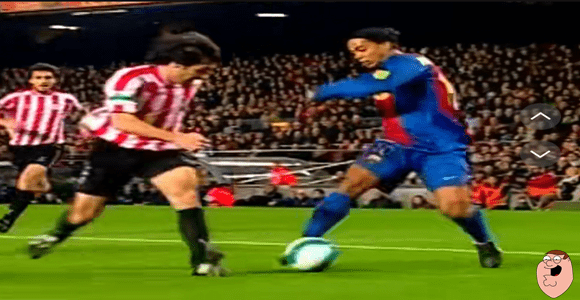
In 2003, Ronaldinho joined FC Barcelona for €30 million, teaming up with rising talents like Xavi, Andrés Iniesta, and later a young Lionel Messi. This move unlocked his full potential. In 145 league appearances, he scored 70 goals (94 in all competitions), delivering breathtaking moments almost weekly.
Under Frank Rijkaard, he helped end Barcelona’s La Liga drought, winning titles in 2004–05 and 2005–06. The pinnacle came in 2006: Barcelona lifted the UEFA Champions League (Ronaldinho was instrumental), and he claimed the Ballon d’Or and multiple Player of the Year awards. His no-look passes, elastico dribbles, and celebration style made him a global phenomenon and symbol of “Joga Bonito” (beautiful game).
**AC Milan: Continued Brilliance Before Decline**
In 2008, Ronaldinho moved to AC Milan. In 76 league appearances, he scored 20 goals, winning Serie A in 2010–11. Though past his absolute peak, he still produced moments of magic and formed strong bonds with players like Kaká. Fitness and lifestyle issues began affecting consistency.
**Return to Brazil and Later Wanderings: Flamengo, Atlético Mineiro, and Beyond**
In 2011, he joined Flamengo, scoring 23 goals in 56 league games and winning the Campeonato Carioca. A move to Atlético Mineiro in 2012 brought renewed success: he helped win the 2013 Copa Libertadores (scoring and assisting prolifically) and claimed domestic honors. Brief stints at Querétaro (Mexico) and Fluminense followed before retiring in 2018.
Across his club career, he amassed roughly 511 league appearances and 205 goals, with higher totals including cups.
**International Career: World Cup Winner and National Treasure**
Ronaldinho earned 97 caps for Brazil, scoring 33 goals. Beyond the 2002 World Cup triumph, he won the 1999 Copa América and 2005 Confederations Cup (where he shone brightly). He captained Brazil at the 2006 World Cup (quarter-final exit) and won bronze at the 2008 Olympics. His international play embodied flair and leadership.
**Playing Style and Personal Charisma**
Ronaldinho’s game blended speed, vision, ambidexterity, and audacity. He made the difficult look effortless and prioritized entertainment. Off the pitch, his smile and love for the game made him universally beloved, though later career partying and fitness lapses drew criticism.
**Post-Playing Life and Legacy**
After retirement, Ronaldinho engaged in business, music, and ambassadorial roles. He remains a global icon, often cited as the player who made millions fall in love with football again.
**Legacy: Why Ronaldinho Transcends Current Stars**
Ronaldinho won the Ballon d’Or, multiple FIFA World Player awards, the World Cup, Champions League, Copa Libertadores, and domestic titles across continents. He is one of the few to achieve such a complete trophy haul alongside pure entertainment value.
Compared to modern attackers: Neymar’s tricks or Musiala’s dribbling echo his style, yet few matched his peak joy, game-changing creativity, and ability to elevate entire teams through charisma alone. In a more rigid, high-pressing era, he reminded the world that football could be art and fun.
Ronaldinho didn’t just play — he danced with the ball and invited everyone to smile along. From the streets of Porto Alegre to Camp Nou glory, his magic transcended statistics. The magician’s touch remains one of football’s most cherished gifts, proving that true legends are measured by moments of wonder they create.